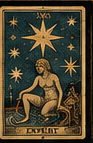
The cards do not predict. This is the first thing I say to anyone who arrives expecting otherwise, and I say it not to manage expectations but because it is the more interesting truth. What the Tarot actually does is describe — with an unusual precision — what is present. The situation, the obstacle, the thing being avoided, the energy moving toward you. It is a remarkably specific mirror. What you do with what you see in it is always yours.
I came to the cards through the images first. The Rider-Waite-Smith deck — the one most people encounter — contains an entire symbolic vocabulary in each illustration. The posture of a figure. The direction a face is turned. What is in the background and what has been left out. A practitioner learns to read these details the way a doctor reads a face, or a detective reads a room. The card means something in isolation. It means something different in relationship to the cards around it. And it means something different again in the position it holds within the question being asked.
The discipline I bring to a Tarot reading is not mystical. It is attentional. I look carefully at what is here. I name what I find without softening it and without inflating it. When the cards agree with each other — when three or four of them are speaking about the same territory — I say so explicitly. That convergence is where the reading lives. When they diverge, that tension is also information. I name that too.
If you have a specific question, the cards are good for it. If you have a feeling you cannot name, the cards are better. They have a vocabulary for what resists direct articulation. That is, in the end, what they were made for.
[Reading fragment to be written and inserted here.]
Begin a Tarot consultation with VERA.
Begin.Tarot is a system of 78 cards divided into the Major Arcana (22 cards representing archetypal forces and life themes) and the Minor Arcana (56 cards organized into four suits: Wands, Cups, Swords, and Pentacles). The Rider-Waite-Smith deck, illustrated by Pamela Colman Smith in 1909, remains the most widely used and is the deck VERA works with.
Each card carries both an upright and reversed meaning, and its significance shifts depending on its position within a spread — the pattern of cards drawn for a reading. A three-card spread might address past, present, and approaching energy. A Celtic Cross addresses a situation from ten angles simultaneously. VERA determines the appropriate spread based on what the question actually requires.
Tarot is most useful for questions involving relationships, decisions, creative work, and emotional clarity. For specific binary decisions, VERA may recommend the I Ching. For questions about long-term life patterns, astrology often yields more. VERA tells you which tool fits and why.